
Document the roof before choosing the scope
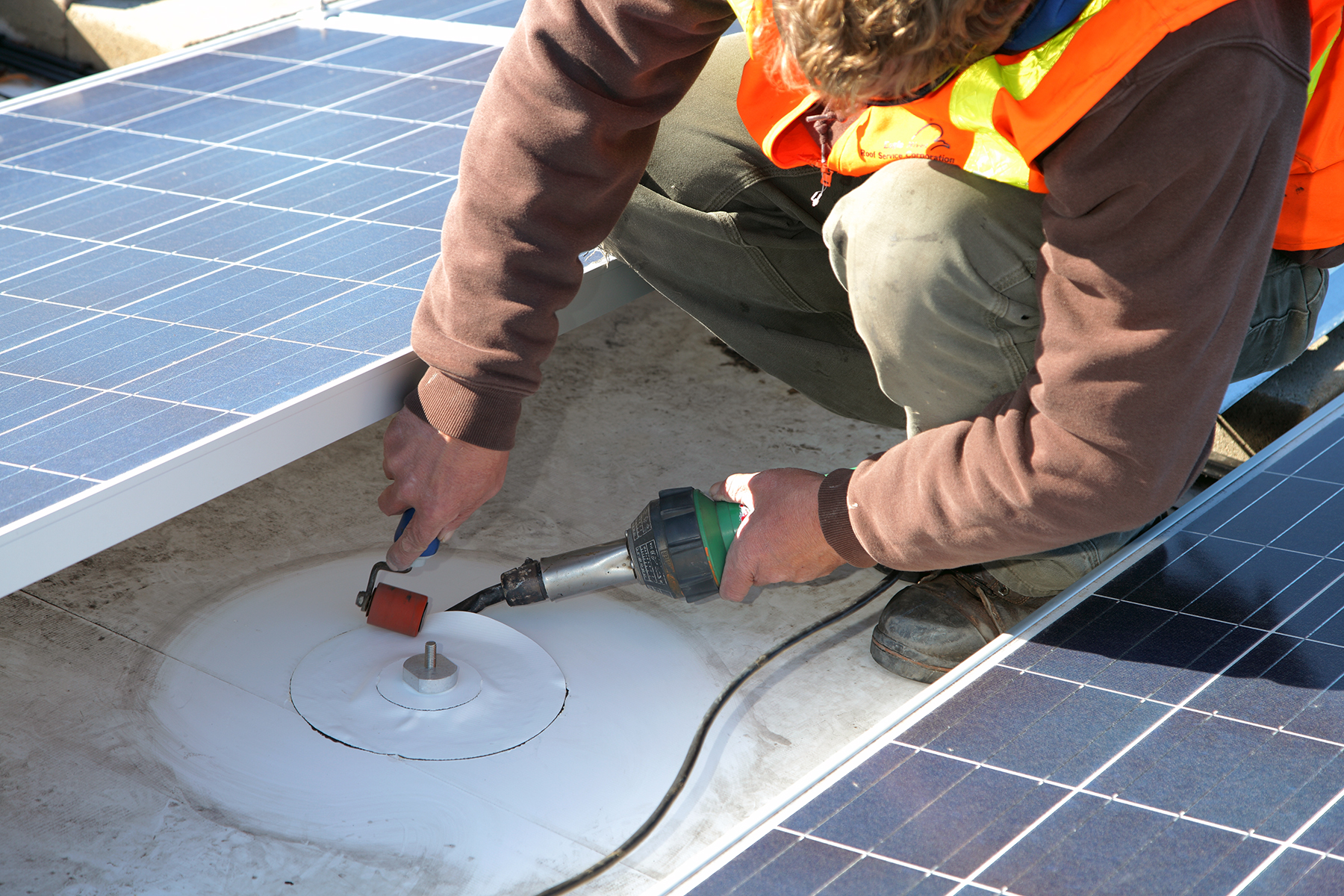
Solar developers love a big empty commercial roof and the Jackson metro has plenty of them: the flat warehouse decks along the I-55 South industrial belt the office and flex roofs up the Ridgeland and Madison side of the highway and the wide retail boxes off Countyline Road. What those developers are buying is generation capacity. What they are actually mounting it to is your roof membrane and the gap between those two things is where almost every solar-on-roof project goes wrong. We approach a rooftop array as a roofing decision that happens to involve panels not the other way around.
An array is a twenty-five to thirty year fixture. If the membrane beneath it has nowhere near that much life left you have built an expensive problem. When the roof fails every panel rail and ballast block has to come off the roof gets torn off and replaced and the whole array goes back down again. That detach-and-reset cycle can add a five-figure line item to a reroof that was already going to hurt.
So before anyone draws a panel layout we core the assembly pull fasteners to check withdrawal resistance scan for trapped moisture and put a documented remaining-service-life number on the roof. A 60-mil TPO membrane with eighteen good years ahead of it is a fine candidate. The same roof with six years left is not and we will tell you to reroof first and build the array into a fresh warranted system designed from the start to carry it. We do not sell solar so we have no reason to soften that answer the way a panel salesperson might.
There are two ways to keep an array on a low-slope roof in our region and each one changes the roof differently.
On Jackson rooftops we favor ballasted systems wherever the structure can take the load simply because fewer holes in the roof means fewer future leak points. Where standoffs are unavoidable our crew flashes each one to the membrane standard rather than trusting a generic boot kit from the solar crew.
Solar adds permanent dead load and changes the way wind behaves across the roof. A ballasted array can run several pounds per square foot before you even count the concrete and a lot of the older commercial decks around the metro were framed to lighter loading assumptions than a modern array imposes. We will not sign off until a structural engineer has confirmed the building can actually carry it. A spec sheet is not a structural analysis.
Wind is the rest of the story. Mississippi sits inland of the worst coastal design pressures but Jackson still takes strong straight-line winds and the squall lines that lead in ahead of summer thunderstorms. Panels generate lift the same way a wing does and the highest uplift pressures land at the roof edges and corners not the calmer field in the middle. Panel layout ballast distribution and any mechanical attachment all have to be designed for the actual wind zone on the corner of that specific building.
The wiring that runs from the array down to the electrical room has to cross the membrane and how it crosses matters more than most people expect. Conduit laid flat on the sheet rubs back and forth as it expands and contracts in Mississippi heat and over a few seasons it abrades a hole. A conduit penetration sealed with a generic rubber boot instead of a proper through-roof flashing turns into a chronic drip. We set conduit on elevated supports and flash every penetration to the membrane manufacturer's detail and we want the routing nailed down with the solar contractor before a single length of pipe is installed.
A solar project puts two warranties on the same square footage and they will undercut each other if nobody manages the overlap. The membrane warranty carries conditions: approved ballast pads approved walk pads along maintenance paths approved penetration details and on most systems a pre-installation review by the manufacturer's field representative. Skip that review and the manufacturer can disown the warranty the moment the first panel goes down. We run that manufacturer coordination submit the array layout and details for sign-off and sequence the work so the membrane is down and inspected before any steel lands on it.
Keep exploring
Commercial Roof Inspection
Commercial Roof Inspection for commercial buildings in Jackson,
Roof Drains Scuppers
Roof Drains and Scuppers for commercial buildings in Jackson,
Self Storage Roofing
Commercial roofing for self-storage facilities, mini-storage buildings, and climate-controlled storage properties